

Concrete Crusher Operator Requirements: Training and Skills
Concrete Crusher Operator Requirements: Training and Skills
What level of equipment operator can run a concrete crusher? A job grade alone does not establish whether someone can operate a particular machine. The decision needs to account for the applicable qualifications, training, demonstrated ability and assigned responsibilities. For a contractor, the practical question is whether the person can operate the supplied configuration safely under the actual site conditions—not simply whether they have worked with heavy equipment before. Relevant experience can contribute to competence, but it does not remove separate duties to provide adequate training and instruction on workplace hazards.
Treat personnel readiness as part of the equipment project: define the job, identify the evidence needed and close any gaps before assigning independent operation.
Does a Concrete Crusher Require a Specific Operator Level?
Job Grades, Training Records and Site Authorization Are Different
A useful way to review concrete crusher operator qualifications is to separate three questions: what training or qualification does the person hold, what tasks can they demonstrate, and what work will the employer authorize? Keeping these questions separate prevents a broad title such as “experienced equipment operator” from becoming permission for every activity around the crusher.
For example, an OSHA 10-hour or 30-hour Outreach card is a course-completion record, not an operator certification or licence. OSHA also states that Outreach training does not replace the specific hazard training required for a worker’s job. A project may require the card, but its presence does not by itself establish competence to operate a crusher.
Apply the Rules for the Country and Type of Site
The following examples illustrate different legal settings; they are not interchangeable qualification systems.
| Work setting | Relevant requirement | Implication for personnel planning |
|---|---|---|
| US construction work covered by OSHA construction standards | 1926.20(b)(4) addresses employees qualified by training or experience. Separately, 1926.21(b)(2) requires instruction in recognizing and avoiding relevant unsafe conditions. | Review both operating qualifications and the job-specific instruction provided. Experience is not a blanket exemption from training duties. |
| Work equipment use in Great Britain | HSE explains the employer’s PUWER Regulation 9 duty to provide adequate training in equipment use, associated risks and precautions. | Relate training to the actual task, equipment, existing competence and supervision. |
| US mines within the scope of 30 CFR Part 46 | Part 46 covers specified mine types; Section 46.7 addresses training for new or changed tasks. | Establish whether Part 46 applies before using its task-training provisions. Do not automatically apply it to every concrete recycling operation. |
When a contract refers to a numbered operator level or named qualification, identify the scheme and its task coverage. Neither a generic “Level 2” answer nor a blanket “no licence needed” statement resolves site-specific requirements. This article is a personnel-planning guide, not an operating procedure or a determination of legal compliance for a particular site.
Match Competence to the Machine and the Assigned Task
Can an Excavator Operator Run a Concrete Crusher?
Excavator experience can be relevant to feeding a crusher, but feeding and controlling the crushing plant are different assignments. HSE’s mobile jaw crusher guidance specifically addresses training the person loading the machine to follow the manufacturer’s recommendations for material presentation and feed rate. That is more specific than the ability to operate the excavator itself.
For crew planning, describe the proposed job in terms of actions: loading material, monitoring the crusher, operating its controls, relocating mobile equipment, or performing maintenance. Assess each assigned activity rather than accepting “runs the plant” as a sufficient job description.
Ruilong’s crushing and aggregate equipment serves equipment buyers and project operators, and its impact crusher product information identifies concrete recycling as an application. That application reference does not establish the acceptable reinforcement, contaminants or feed conditions for every configuration; those details belong in the machine-specific supply and operating information.
Mobile Crusher Operator Competency Depends on the Configuration
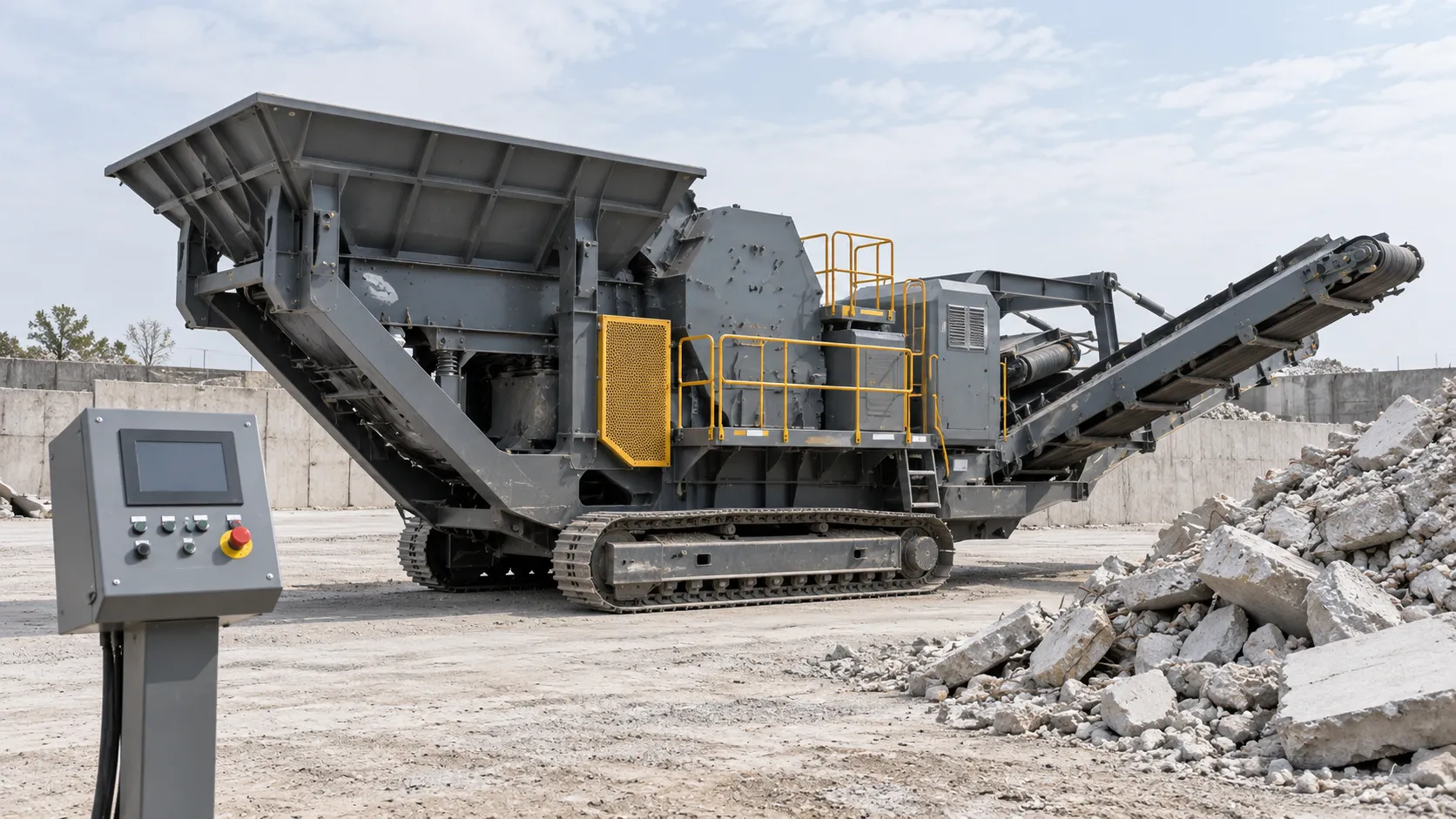
The company’s mobile crushing configurations include tracked or wheeled arrangements for applications such as temporary sites and contractor work. Personnel planning therefore needs to identify which supplied arrangement the crew will actually use.
For a proposed mobile installation, map the operator’s position against the feed area, discharge equipment, traffic routes and communication arrangements. Include repositioning only when it is part of that person’s assignment. Treat any remote-control function as an additional system to understand, not as evidence that the entire operation can be managed by one person.
This task map is a planning tool, not a prescribed staffing ratio. Its purpose is to expose responsibilities that would otherwise remain hidden inside a general operator job title.
What Must a Concrete Crusher Operator Be Able to Demonstrate?
Recognize Unsuitable Feed Before It Reaches the Hopper
HSE identifies oversize material, overfeeding, tramp metal and discharge buildup among the causes of blockages in mobile jaw crushers. It links prevention to material preparation, appropriate feeding and the manufacturer’s instructions. These relationships make feed recognition an operating skill, not merely a purchasing specification. The guidance is specific to mobile jaw crushers and is not an operating manual for an impact crusher.
An assessment can use photographs or safely presented material examples to ask which items meet the agreed feed specification, which require further preparation and which need escalation. The answer should refer to the supplied machine’s limits rather than a rule of thumb about what concrete crushers generally accept.
Assess Decisions, Not Just Familiarity with Buttons
Use a record that captures what the person actually demonstrated. The following is a suggested assessment format—not a certification standard or a description of a manufacturer’s training course.
| Assessment area | Evidence to seek | Reason to withhold the relevant task pending further instruction |
|---|---|---|
| Feed acceptance | Explains the applicable material limits and identifies examples outside them. | Relies on appearance alone or assumes all demolition concrete is acceptable. |
| Normal controls and observations | Identifies the controls and indications relevant to their assignment and explains the prescribed response. | Recognizes buttons but cannot explain the associated operating conditions. |
| Coordination with other personnel | Demonstrates the agreed communication method and explains how changes in feeding or discharge are communicated. | Cannot identify who controls the next action when communication is lost or instructions conflict. |
| Abnormal conditions and work limits | Explains whom to notify and where their authority ends. | Treats access to a stopped machine as automatically permitted or includes unassigned repair work in normal operation. |
Keep the exercise within an approved, safely supervised assessment. Do not create a live blockage or defeat a protective device to test someone’s response. Discussion, photographs and demonstrations under safe conditions can assess decisions without deliberately producing a dangerous fault.
Include Pre-Use Checks and Dust-Control Awareness
HSE’s inspection guidance recommends determining inspection needs from the risks, equipment condition and manufacturer’s advice. It also distinguishes simple checks from more extensive inspections. Anyone carrying out an inspection needs to know what to examine, what defects matter and what response is appropriate.
Apply that distinction to the operator’s assignment. A pre-use check can include the specified accessible guards, warning indications and protective systems without giving the operator authority to dismantle equipment or perform a specialist inspection. Record a defect and the required response, not just a completed tick box.
Dust control requires similar specificity. For US construction work using the specified exposure-control approach in OSHA 1926.1153 Table 1, the crushing-machine entry combines water spray or mist at dust-generating locations with specified operating and maintenance practices and a ventilated booth or remote-control station. A spray nozzle alone is not the complete Table 1 arrangement. Tasks that do not fully implement the specified controls fall under the standard’s alternative exposure-control requirements.
The operator’s assessment should therefore address the controls actually required on that project, how their condition is checked and how a failure is reported and handled under the site’s procedure. It should not assume that every machine includes identical dust-control equipment.
Separate Routine Operation from Blockage Clearing and Maintenance
A Stopped Crusher Is Not Necessarily Isolated
Pressing a stop control does not, by itself, establish that all hazardous energy has been controlled. HSE’s maintenance guidance distinguishes stopping equipment from isolating its energy sources, preventing unintended re-energization and addressing stored energy or unsupported components. These are separate safeguards, not different names for the same action.
Crusher blockages add another important boundary. Ireland’s Health and Safety Authority warns that a blockage can retain stored energy even when the machine is de-energized and isolated; sudden release can eject material or machine parts. Isolation is therefore not permission to improvise a clearing method. The task requires the applicable machine-specific procedure and competent personnel.
Normal crusher operator authorization should make this boundary explicit. Knowing how to recognize an abnormal condition and initiate the prescribed response is different from being assigned to enter a danger area, remove a guard or carry out a repair.
Define Intervention and Return-to-Service Responsibilities
Before production, identify who receives a fault report, who assesses the required intervention and who controls the return to operation under the site procedure. HSE advises using competent personnel for maintenance, providing sufficient information and instruction, and planning the work with the manufacturer’s guidance.
Document these responsibilities as named roles rather than assuming that whoever operated the crusher last is responsible for every subsequent decision. A useful boundary statement specifies the operator’s normal duties, the escalation contact and the intervention tasks excluded from that assignment.
Assess Existing Experience Before Allowing Independent Operation
Plan Concrete Crusher Operator Training Around the Gaps
Start with evidence of previous tasks, not years of employment alone. Ask which equipment the person operated, which duties were included and how those duties relate to the proposed assignment. Then use the assessment results to identify what still needs instruction or supervised practice.
Consider a hypothetical excavator operator who handles approved feed correctly but cannot explain an unfamiliar crusher alarm or the site’s communication protocol. Their loading experience remains relevant. The gap concerns the additional crusher-control assignment. A reasonable assessment outcome is to address that gap and reassess the task, rather than treating either all previous experience or all further training as irrelevant.
For mines covered by US Part 46, Section 46.7 provides a specific example of how experience must be evaluated. Its provision for previous training or experience in a similar task depends on demonstrated skills and an observation of safe performance. Closely observed practice has its own conditions, including prior instruction in task-specific hazard recognition. This provision is not a general training exemption for construction or recycling sites outside that scope.
Check Understanding and Reassess When Work Changes
The operator needs to understand the information, not merely receive it. OSHA’s recommended practices call for education suited to workers’ language and literacy, opportunities to ask questions and additional training when equipment, materials, processes or work assignments change. These are practical considerations when arranging manuals, demonstrations and site instruction for a multilingual crew.
For an assessment record, include the machine and control configuration, tasks observed, limitations, outstanding instruction and the person responsible for the assessment. Describe what remains restricted while a gap is being addressed. This proposed record structure helps the next supervisor distinguish demonstrated skills from assumptions.
Do not set a universal number of training days simply from the equipment category. HSE relates adequate training to the work, existing competence, equipment and supervision, and notes that equipment or work-system changes may require further training. An operator moving to a different configuration needs a gap review, not an automatic transfer of every previous authorization.
Include Operator Handover in the Equipment Purchase
Request Documents for the Supplied Configuration
For concrete crushing equipment procurement, specify the information needed to connect the delivered machine with the crew’s actual duties. Request the corresponding operating and maintenance instructions, feed restrictions, control and alarm information, and the agreed commissioning and handover scope.
Make the request specific. “Provide a manual” leaves its usefulness unresolved; identifying the supplied model, control version and working language gives the purchasing team something concrete to check. Similarly, requesting the feed acceptance conditions supports the material-recognition assessment, while requesting maintenance responsibilities helps separate operator duties from specialist work.
Agree who will attend the handover and which questions it must resolve. Ask for unresolved items to be recorded rather than allowing completion of a demonstration to imply that every operating question has been answered. These are proposed procurement checks, not claims that every supplier includes the same documentation or training package.
Separate Manufacturer Handover from Operator Authorization
Ruilong’s installation, commissioning and operator handover service describes operating-sequence information, maintenance notes and spare-part communication for site teams. Its published scope does not establish that the service awards an accredited operator qualification or a statutory licence.
Treat that handover as information about the supplied equipment. Keep any independently required qualification, the employer’s task assessment and the site’s operating authorization as separate items in the project plan. This avoids purchasing an equipment service under the mistaken assumption that it also settles every personnel requirement.
Confirm Crew Readiness Before Scheduling Production
A useful readiness decision answers a precise question: which person is prepared and permitted to perform which task on this configuration, under these site conditions? Record the supporting evidence and any remaining restrictions. That is more useful to a production manager than an unexplained operator level.
For a project discussion, identify the country and site type, the concrete feed and preparation plan, the proposed fixed or mobile arrangement, and the crew’s relevant experience. Add the working language and the equipment information or handover support needed. These details let the conversation address both the supply configuration and the practical information needed for personnel preparation.
Use the project inquiry form to discuss equipment and handover requirements. The form accepts material, capacity, output and project details, which can provide a starting point for defining the proposed equipment scope. The purchasing team can then coordinate the agreed manufacturer information with the employer’s training, assessment and authorization arrangements before scheduling production.